HOPE: exploring slow technology through play
An interactive hopscotch mat that uses movement, light and storytelling to help displaced children communicate with each other, designed and prototyped during a workshop at Domus Academy, Milan.
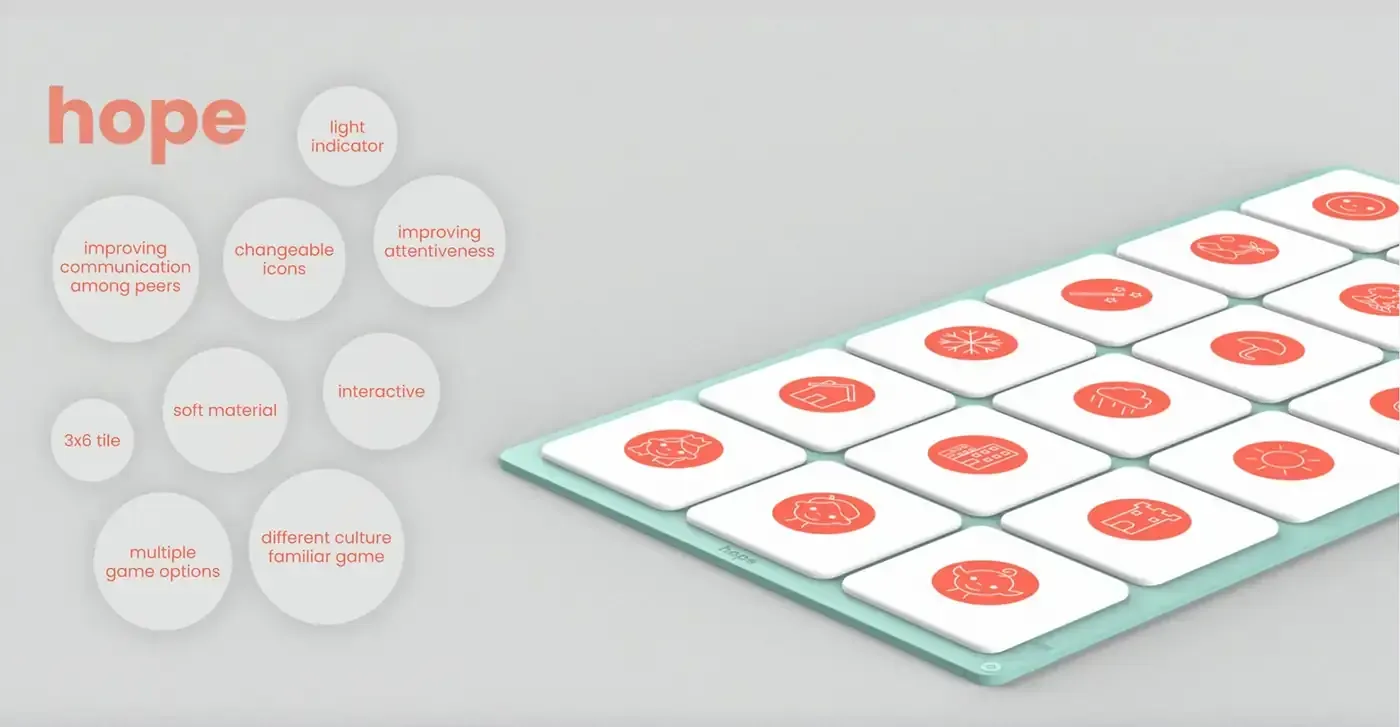
Technology doesn't always need a screen
HOPE came out of the Experience Design and Tangible Interactions workshop at Domus Academy in Milan. The brief was deliberately open. Pick a problem worth solving, and approach it through the principles of Slow Technology.
That is an idea, not a product. The interesting part was not defining it. It was working out where it might actually be worth something, and for whom.
From slow technology to quality education
We went looking through the United Nations Sustainable Development Goals for a context where an unhurried, physical, shared technology could do real work. We landed on SDG 4, Quality Education, and specifically Target 4.5, which calls for equal access to education for vulnerable children.
What narrowed it further was personal rather than analytical. One of our teammates has a mother who taught and volunteered with refugee children in the earthquake camps in Turkey. She could tell us what those classrooms are actually like.
So the focus became children who have been displaced, and what happens when they arrive in a school where they do not yet share a language with anyone in the room.
Talking to the people already in the room
We spoke with six to seven teachers and volunteers working with displaced children across Turkey, Europe and Africa. These were conversations, not a formal study, and I want to be clear about that. What they gave us was a picture of the classroom from people standing in it.
We went in with three questions.
Who are the learners?
Their age, their behaviour, the context they arrive from, and what educational support already exists around them.
What gets in the way?
The barriers to education, to communication and to social interaction with the other children.
What keeps them going?
What helps a child feel comfortable enough to join in, and to keep learning through circumstances that would stop most adults.
Three things that changed the direction
Learning can be sensory
Educators were already using computers, speakers, visual activities and physical activities to hold attention. Learning did not have to arrive through a traditional classroom interaction, because in these classrooms it frequently did not.
Storytelling creates connection
Activities where children share something personal, the story behind their name for instance, gave them a reason to speak and something to recognise in each other.
Play lowers the barrier
Play let children participate before they were ready to talk. It created the spontaneous social contact that a structured lesson could not.
Read together, those three point somewhere specific. The thing standing between these children and each other was not a shortage of educational content. It was a shortage of low-pressure reasons to interact.
Defining what we were actually solving
How might we help children aged three to seven who have experienced displacement overcome barriers to communication and build connections with peers in their new school environments?
The obvious response to a problem in education is an app. We had just spent three conversations hearing that these children are already surrounded by screens, that devices are not evenly available, and that what works is physical and shared.
That question is where Slow Technology stopped being an academic framing and started being a constraint we could design against.
Five rules we held ourselves to
No screens
The experience must not require a child to operate a conventional digital interface.
Learn through play
It should feel like a game, not like another classroom exercise wearing a costume.
Play together
The interaction has to work for several children at once. A single-player object solves the wrong problem.
Encourage storytelling
The activity should create natural openings for a child to say something.
Keep technology in the background
Technology should enable the experience without becoming the thing everyone is looking at.
Finding the right form of interaction
The final concept did not arrive first. We went wide before we went deep, sketching games that already exist in some form in most cultures: origami, dice games, hide and seek, spin the bottle, an alphabet game, a magic board. Alongside them we explored physical formats, looking for something that could be modular, foldable and cheap enough to matter.
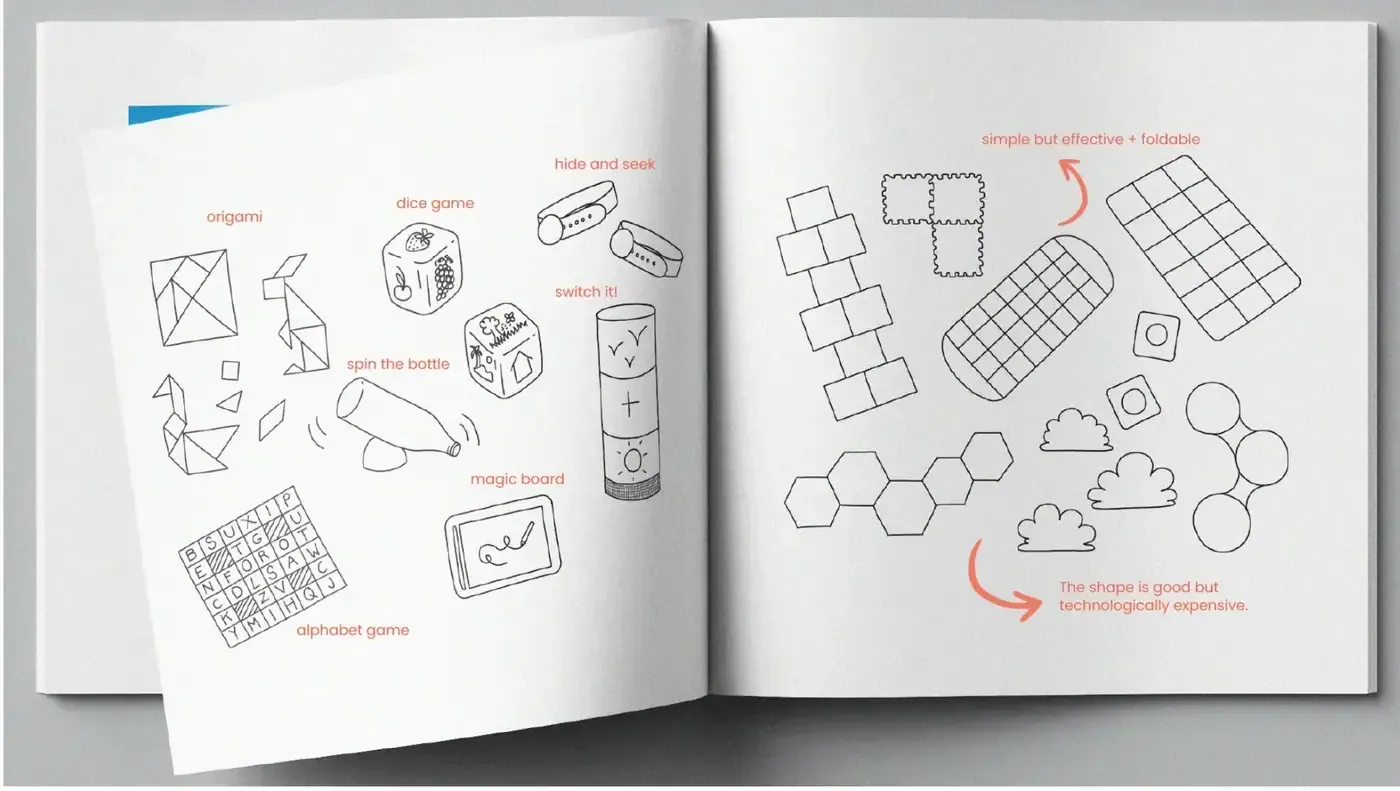
Two concepts survived that pass.
Concept 01: interactive hopscotch
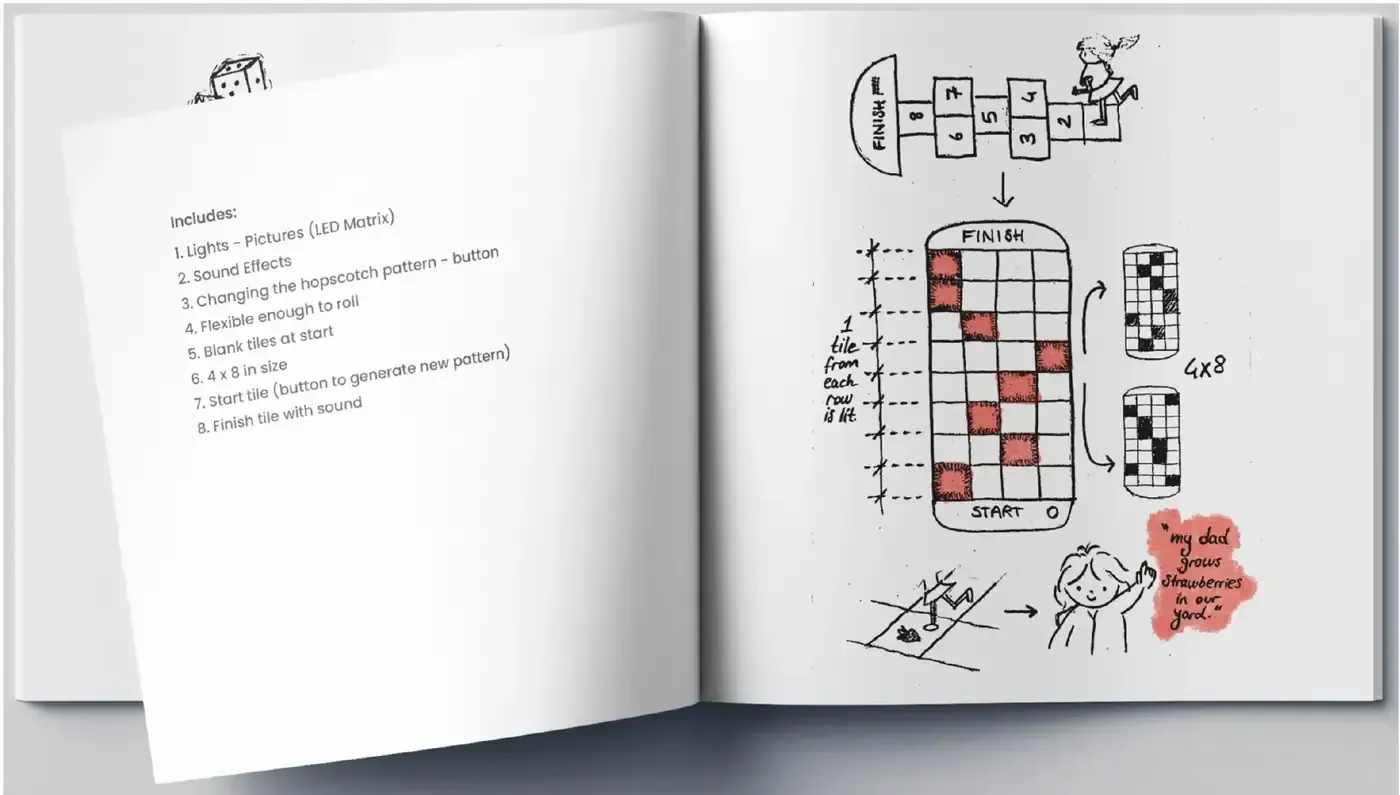
A familiar childhood game becomes a medium for storytelling. Tiles light up and guide children through a sequence. It needs no explanation because most children already know how to play it, and it takes a whole body to use.
Concept 02: tangram board
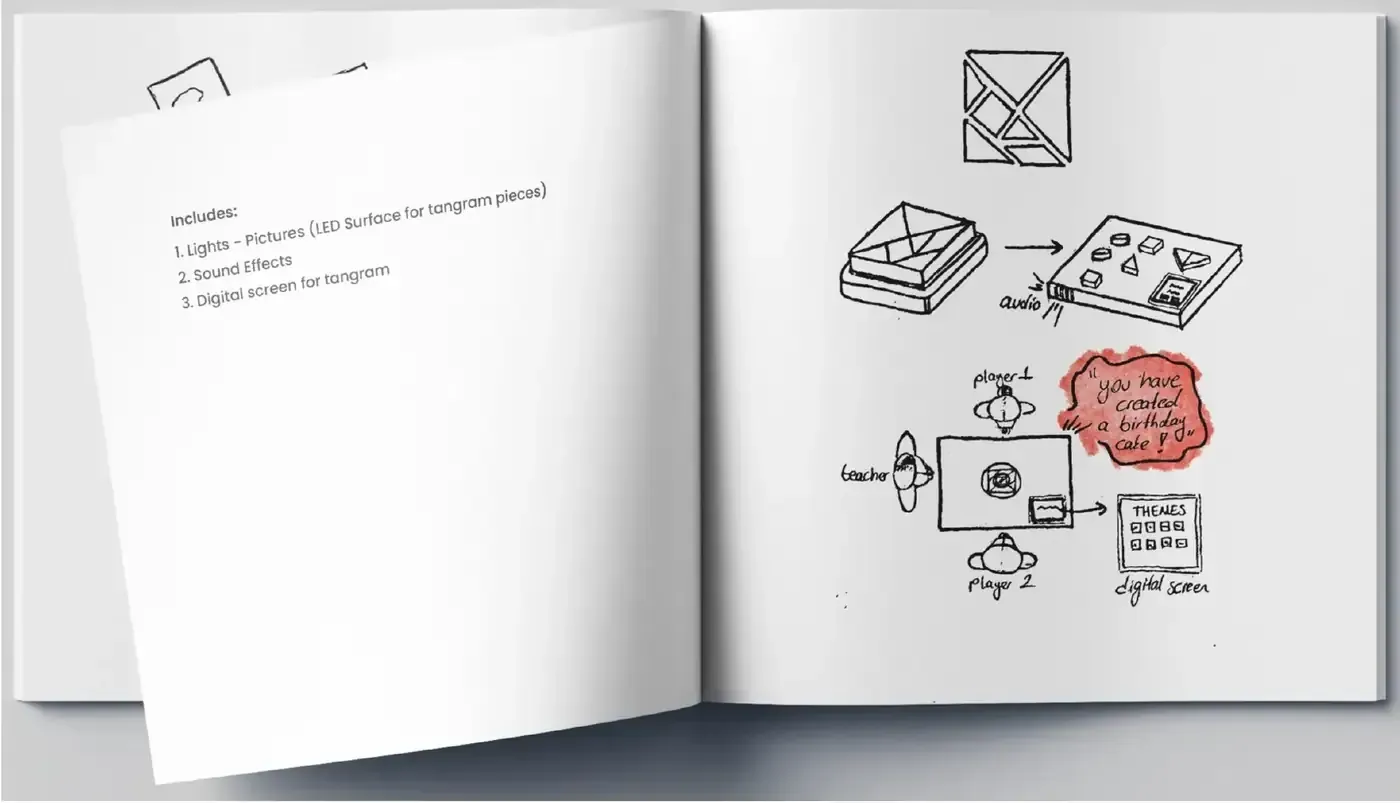
More portable, far easier to prototype, and honestly the safer choice. It also drifted away from the point.
| Interactive hopscotch | Tangram board | |
|---|---|---|
| Players | Several at once | One or two |
| Ease of understanding | Strong | Medium |
| Nature of the task | Physical and social | Individual problem-solving |
| Spontaneous group interaction | Strong | Limited |
| Ease of prototyping | Low | Strong |
| Portability | Low | Strong |
Why we went back to hopscotch
Reading down that table, the tangram board wins on everything except the two rows that were the actual brief.
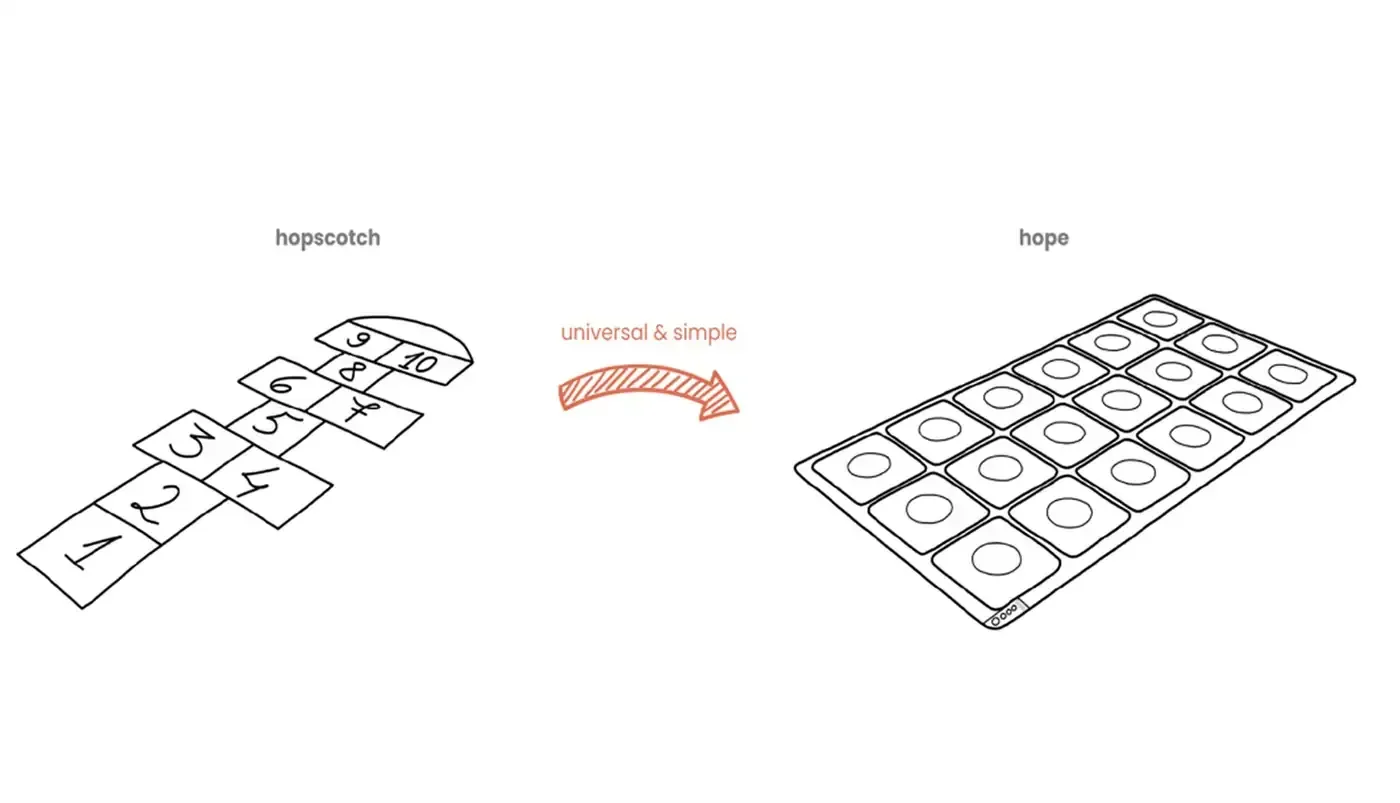
The chain from research to decision is short enough to state plainly.
- Play lowers the barrier
- Play together
- Hopscotch
We heard that play creates the social contact structured lessons cannot. We turned that into a principle: whatever we build has to work for several children at once. Hopscotch was the only concept that satisfied it, because it is played in a queue by definition. Somebody is always waiting, watching and reacting.
After discussion with the jury we kept the hopscotch concept and cut the scope instead, building a scaled prototype rather than a full mat. That was the right trade. Prototyping difficulty is a schedule problem. Designing for one child when the brief asks for several is a design problem.
A physical playground for storytelling
HOPE is a foam mat carrying a grid of tiles. Tiles light from underneath, respond to a child stepping on them, and prompt whoever is standing there to say something. Movement, light, pressure and storytelling, and no screen anywhere in it.
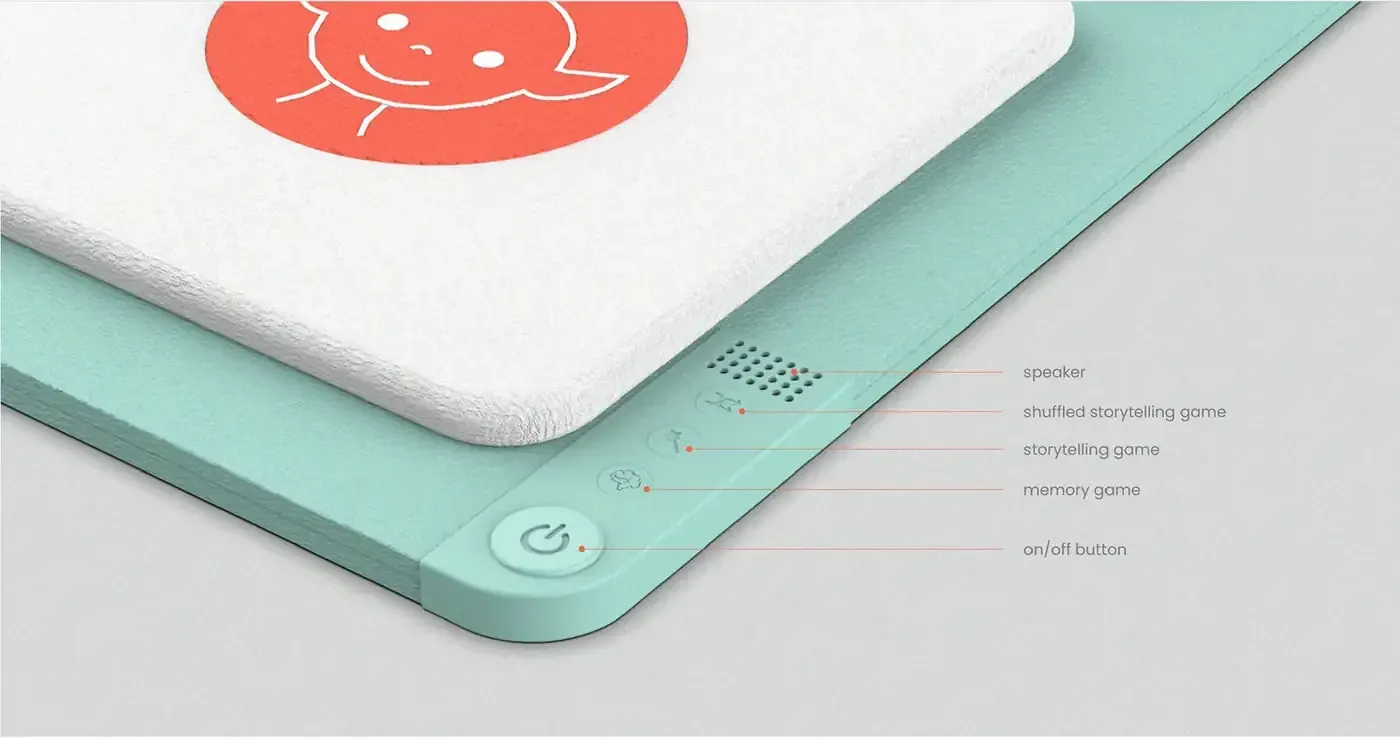
That control strip is the clearest expression of the no-screens principle. Everything an adult needs to operate the mat sits on one edge in four elements. The child never touches it. The mat carries three modes; the two storytelling games are the ones we developed in detail.
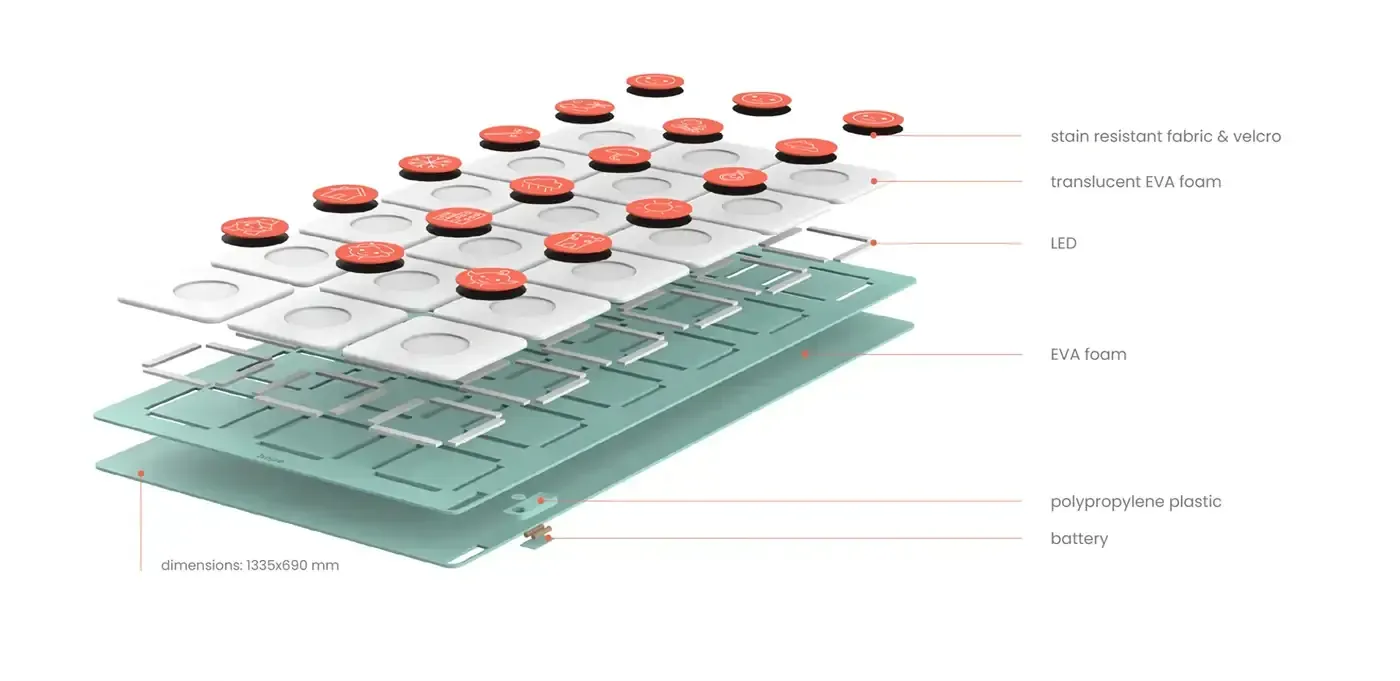
The construction carries most of the design decisions. Icons attach with velcro, so the vocabulary of the game can be changed for a different group of children rather than being printed in at the factory. The foam is translucent, so light arrives as a glowing tile rather than as a visible source. The fabric is stain resistant, because the object lives on the floor of a classroom. The whole thing is 1335 by 690 millimetres and runs on a battery, so it rolls up and goes somewhere else.
Two ways to tell a story with your feet
Shuffled storytelling
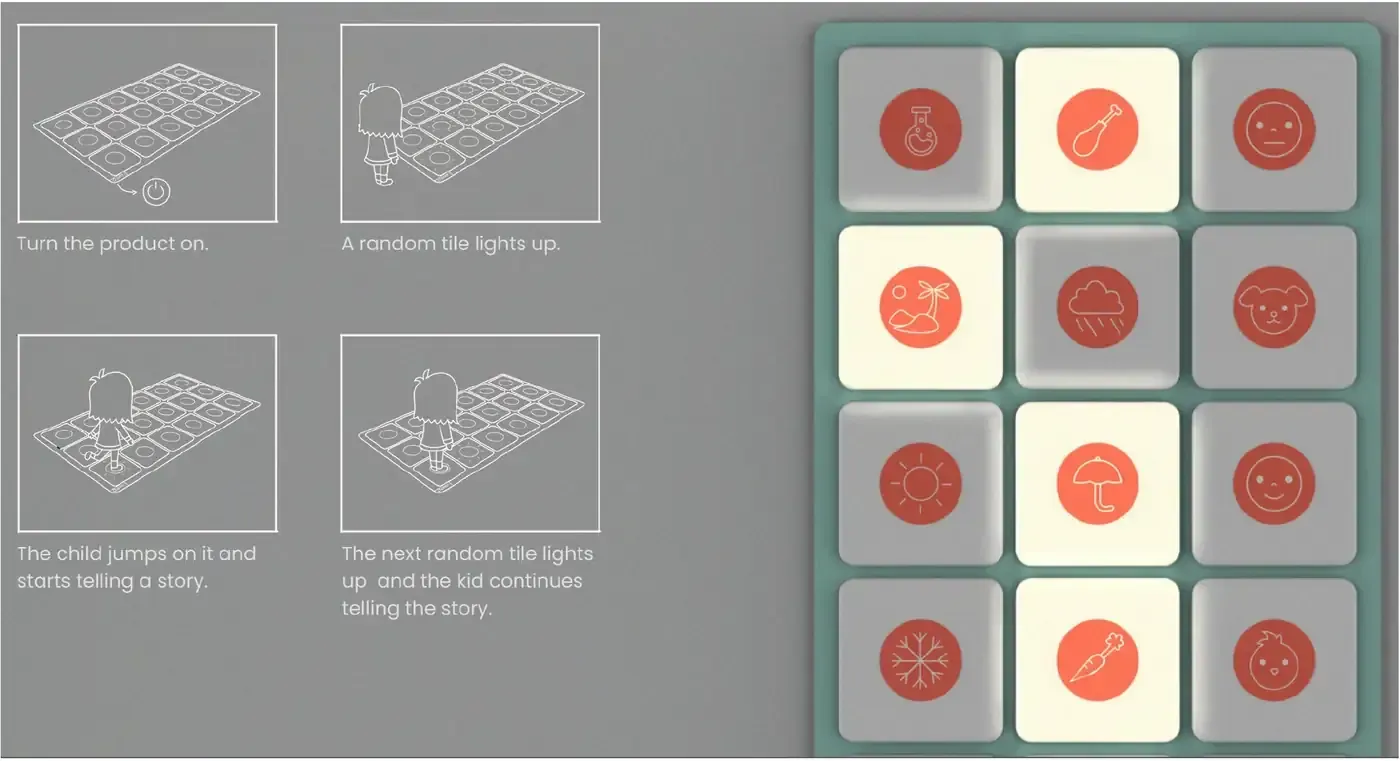
- Watch for the glowing tile
- Jump on it and start your story
- Another tile lights, continue the story
- Follow the path and see where it goes
The design intent here is to remove a specific pressure. Asking a five-year-old what they would like to tell everyone about is a hard question, particularly in a language they are still learning. The mat answers it for them. The child is not inventing from nothing, they are reacting to a picture, which is a much smaller ask.
Memory path storytelling
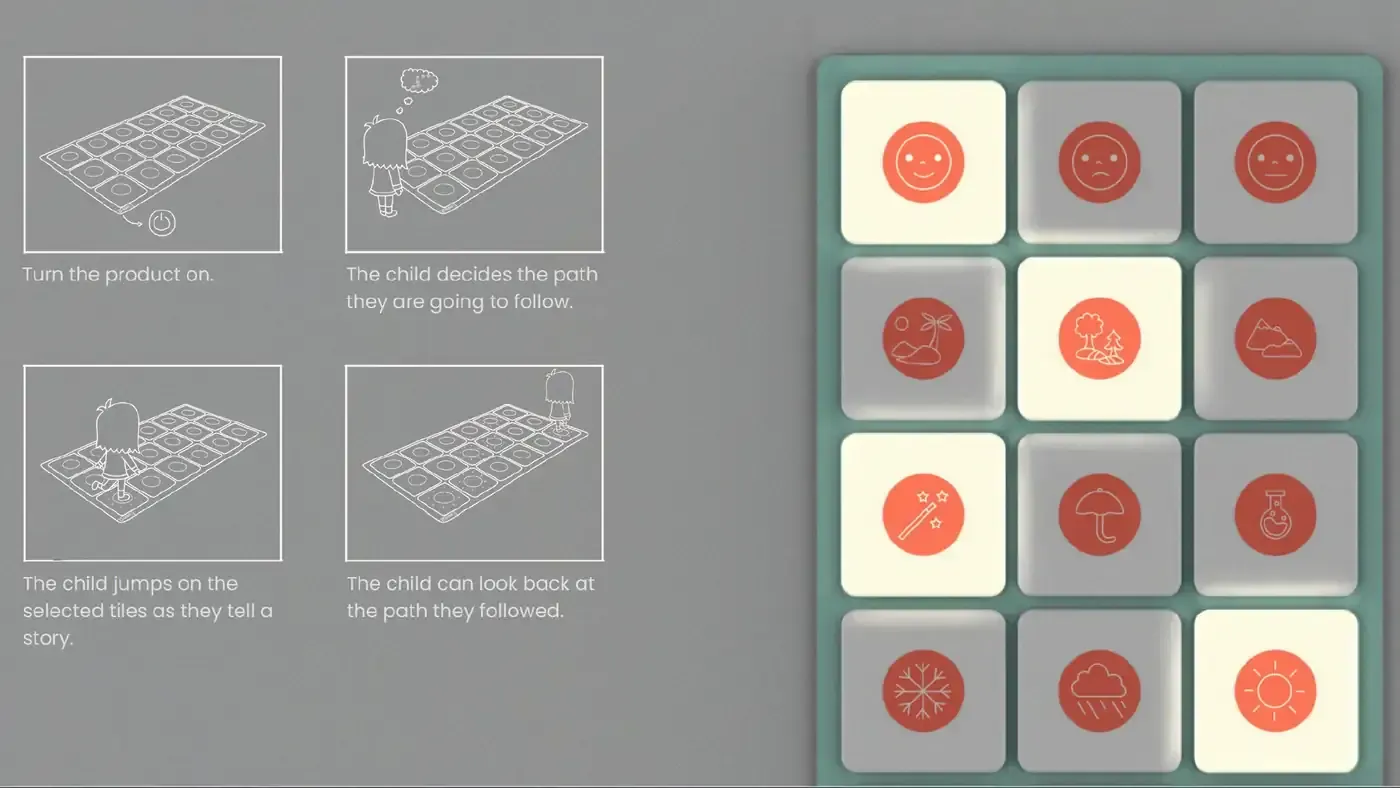
- Choose your path
- Jump across the tiles
- Tell a story as you move
- Look back at the path you made
This one inverts the authorship. The child decides the route, and the tiles stay lit behind them, so the story has a physical record. They can turn around and see it, and so can everyone waiting for a turn. That last step is the one I would keep if I could only keep one thing.
From an idea on paper to something that responds
Before committing to a built mat we tested whether the interaction was any good using cardboard, printed icons and a single LED.
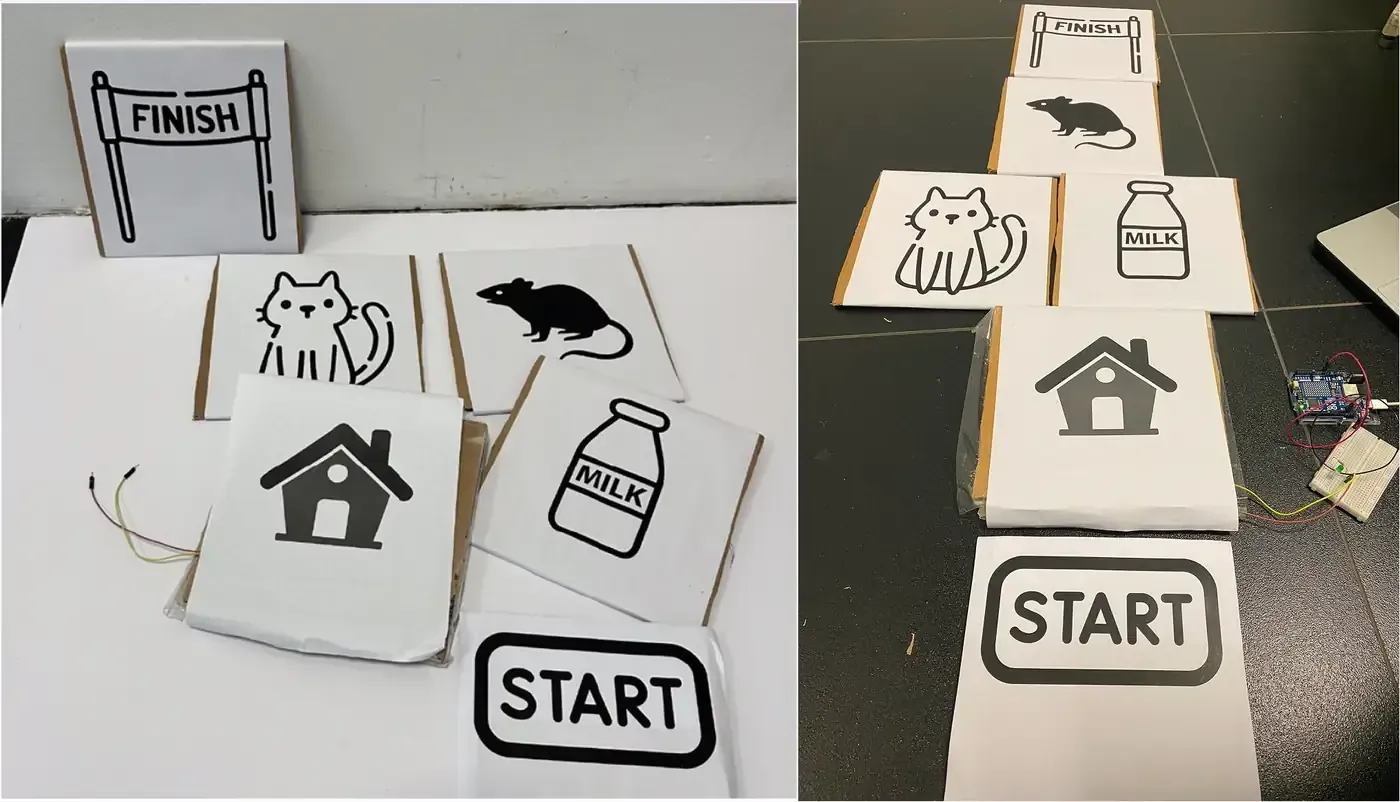
It cost almost nothing and answered the only question that mattered at that stage. A path of pictures does prompt a narrative, and the sequence does keep people moving.
What I worked on
The team was four designers, and the split was along disciplines. The product designers took the physical form, the 3D models and the construction. I took the interactive layer.
- Arduino circuits and the wiring for the tile grid
- Pressure detection, so a tile knows a child is standing on it
- LED behaviour and the light feedback a child actually sees
- The interaction logic behind both storytelling games
- Testing the electronics in the paper prototype before anything was built
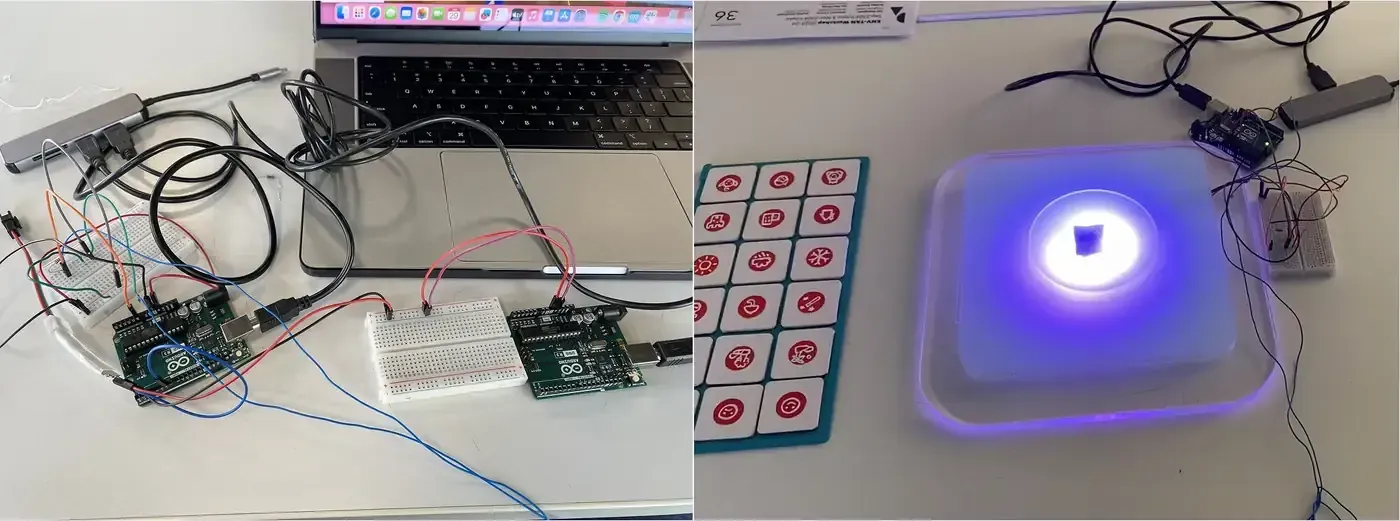
Getting a tile to glow evenly is where the interaction stopped being a diagram. Too bright and it is a light source competing for attention, which is the opposite of what Slow Technology asks for. The answer was diffusion rather than dimming, which is why translucent foam ended up in the final construction.
The physical build happened in the workshop alongside the electronics.
Foam tiles cut and stacked, acrylic drilled, the hope mark embossed into
a plate, components laid out and assembled by hand.
Working next to product designers changed the interaction design rather than merely implementing it. A question like how thick the foam can be before a five-year-old cannot trigger the sensor is not a question I would have known to ask on my own.
It cuts the other way too. The decision to diffuse the light rather than dim it came out of the electronics bench, and it ended up shaping the material stack. Neither discipline could have arrived at the tile on its own.
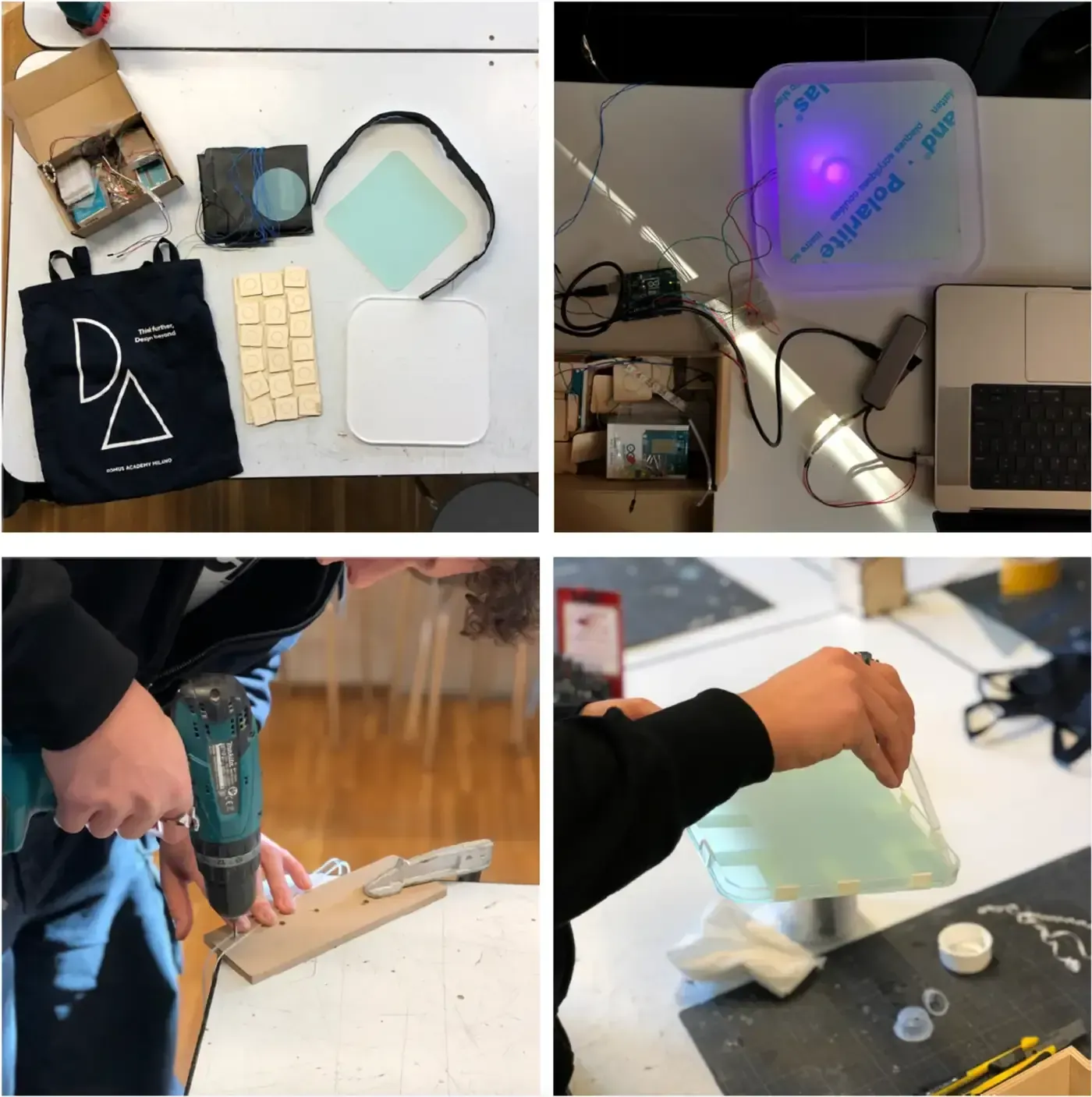
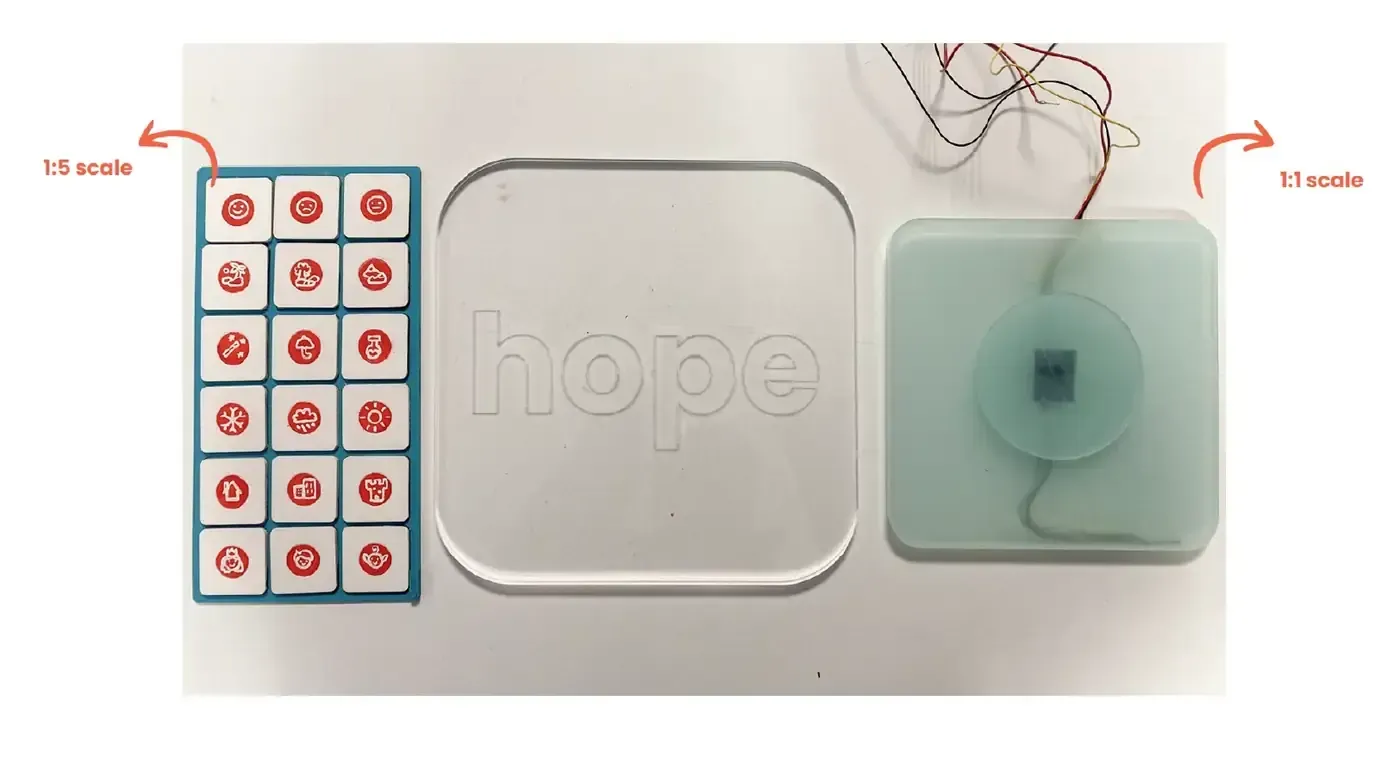
This is the honest version of the outcome. The full mat was never built. We built the grid at one fifth scale to demonstrate the game, and one tile at full scale to demonstrate the interaction, and put them next to each other.
What was hard, and what I took from it
What was difficult
Designing for a complex social problem
Working on displacement meant constantly checking whether we were designing from evidence or from our own assumptions about childhood. Speaking to educators was the main defence against that, and it was not a complete one.
A short timeline
A workshop project could not produce a full-scale interactive mat. Scaling the prototype was the compromise that let us show the interaction rather than describe it.
Physical prototyping
Electronics, durability, portability, assembly, pressure sensing and lighting are all constraints a screen-based project never has to hold at once.
Working across disciplines
Interaction ideas had to survive being translated into a physical object with manufacturing constraints. Some of them did not, and that was usually the right outcome.
What I took from it
The best interface is sometimes no interface
The most meaningful interaction here happens when the technology disappears into the floor and the children are only aware of each other.
Physical interaction opens different doors
Movement, pressure and light gave us a design vocabulary that no screen could have offered, particularly for children who do not yet share a language.
Play is a communication tool
It creates a low-pressure environment where a child can participate before they are ready to speak, and that turned out to be the whole mechanism.
Prototyping changes the idea
Electronics forced us past what looked convincing on paper. Several decisions in the final construction exist only because something failed on a bench.
Collaboration expands the solution
Working with product designers turned an interaction concept into an object that could survive a classroom floor.
Where this actually stands
HOPE is an exploratory interaction design project and a scaled physical prototype, made during my studies at Domus Academy. It was never manufactured, never deployed in a classroom, and never tested with the children it was designed for. Any claim about how well it works would be a claim I have no evidence for.
What it did do was change how I think about technology. We usually design it to make people faster, more productive and more connected. Sometimes the better experience is the one that asks less of you.
In HOPE the technology sits in the floor. It responds to a child jumping, and then it gets out of the way.
Sometimes the most human technology is the technology you barely notice.